|
|
Current Developments
Introduction
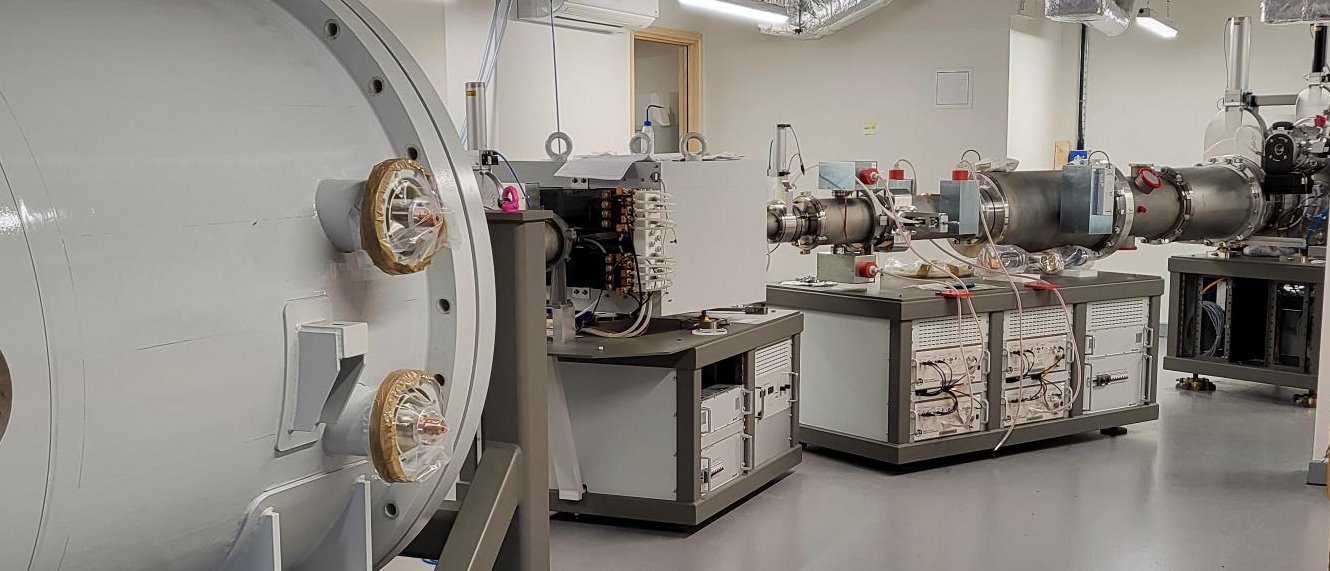
Over the past 15 years the Ion Beam Centre has been engaged in a programme
to replace its
three main accelerators
. This replacement programme is now complete.
The accelerators in the Ion Beam Centre form
the basic machines around which technological developments are implemented.
The main equipment developments made by the Ion Beam Centre are in improvements
to beam-lines, target chambers and ion sources.
We also describe the improvements that will be necessary to maintain state of the
art facilities over the next 10 years. These plans are continuously evaluated,
reviewed and discussed on a six monthly basis with the IBC steering committee.
New items enter the discussions via a number of routes:
- discussions with users of the facilities; this determines the need
for higher precision and/or accuracy or for the development of a new or upgraded
capability;
- discussions with the international community; this indicates new developments
that can be made which will improve or extend the facilities on offer;
- internal quality assurance programmes show areas that can be
improved.
The plans presented here, have been compiled using a combination of these
inputs.
To date, most of the Ion Beam Centre’s work has concentrated on the exploitation
of ion beams in micro-electronics. Although it is quite clear that there
is still substantial work to be done in this area, it is also apparent that
there are new and exciting fields of research opening up and the IBC should
be positioned to play a pivotal role in their development. Much of this research
is multidisciplinary and involves micro and nano-scale materials fabrication,
characterisation and processing. Such techniques can be applied, for example,
to microelectronic materials, more esoteric materials and biological systems.
The new machines that have been commissioned in the Ion Beam Centre over
the past few years have enabled it to increase the through-put of samples
and at the same time the machine reliabilities have improved. This means
that the Ion Beam Centre is ideally situated to expand its interests and
look for new applications in which ion beams can be utilised. In
particular we see our provision expanding into the areas of
lifesciences, nano-fabrication and nano-analysis as well as providing
a unique external beam facility, in the UK.
We aim to do this by developing new beam lines on the Tandem accelerator
to provide a nano-beam complex which will allow the analysis and structuring
of materials on the nanometre scale. This will allow us and users of the
Centre to observe the effects of radiation on living cells and to analyse
cells in culture as well as exploiting the properties of MeV protons to manufacture
high aspect ratio nano-structures. At the same time we will look to expand
the capabilities of our conventional implanters to enable us keep track with
industrial size wafers and expectations of uniformity and precision.
Current Capability
Ion Beam Analysis
The 2MV tandetron is now completely installed and operational with two beam
lines up and running: a broad beam line which can be used for RBS, EBS, NRA
and ERD with channelling; and a microbeam line, which can be used for PIXE,
RBS, STIM, IBIC, and channelling. The former beam line incorporates
a 6 movement goniometer which can be accessed via an air locked sample loading
facility. The sample plate size is 100mm × 150mm allowing many
samples to be loaded together. The software driving the goniometer
has been significantly upgraded and the system is now almost fully automated.
The DataFurnace
software
developed by the Surrey IBC is a world-leading code able to automatically
extract composition depth profiles from IBA spectra (including RBS, EBS,
ERD and NRA spectra). There is nothing else available that is competitive
with DataFurnace. We have licensed this new technology to 13 international
labs so far (at £2000 per licence) and there is considerable interest.
A Topical Review has been published recently by
J.Phys.D (Jeynes et al., 36, 2003, R97-R126).
Examples of work conducted on this beam line include:
- participation in a major Round Robin led by the National Physical Laboratory
under the CCQM (the Consultative Committee on the Quantity of Material:
a committee of the ISO) to measure the thicknesses of ultra-thin SiO
2 films on silicon. The oxygen content of 2nm films could
be measured by EBS (3.036MeV He) with a demonstrable precision of 4%
. The beam energy is known to < 0.017%; (
see Newsletter1)
- medium dose As implants (5 x 1015cm-2) can be
measured routinely by RBS at 1.4% absolute accuracy, with reproducibility
and internal consistency demonstrated in the data set;
- determination of H profiles in "Ion Cut" GaAs samples by 5.5MeV He
RBS/ERD;
- determination of In content of MOVPE InGaN samples, for critical comparison
with EPMA;
- RBS/channelling of 18O damage profiles in sapphire for microwave
assisted annealing studies;
- ERD/RBS of H profiles in CVD a-Si:H for solar power;
- glancing exit channelling measurements for improving accuracy of depth
resolution for shallow junction implants (see Newsletter
2)
The second beam line is a microbeam line having a beam spot of 1 µm.
Further optimisation of this beam line will reduce the beam spot diameter
to below one micron. This beam line is routinely used for micro PIXE,
RBS and IBIC analysis. STIM has also been demonstrated.
Examples of work conducted on this beam line include:
- PIXE and RBS analysis of proteins; (see Newsletter
1)
- PIXE and RBS analysis of a volcanic plume (see
Newsletter 1)
- IBIC analysis of cadmium mercury telluride and CVD diamond detectors;
- PIXE analysis of tree rings for pollution study;
- RBS/PIXE of inkjet deposited copper;
- D profiles by 3He NRA/PIXE for diffusion in & out of polymers for
controlled drug delivery.
Ion Beam Modification
The implantation laboratory has
two research implanters
purchased in 1991 and 1997 which have been under continual development and
improvement during this time. The machines cover a terminal voltage range
of 2-200kV (Danfysik) and 200-2000kV (HVEE 2MV).
The Danfysik machine has two beam lines: a semiconductor line leading to
an implantation chamber housed in a class 100 clean room; and a general
line capable of implanting large area samples (up to 40x40 cm).
The HVEE 2MV machine has only a single beam line which links to a target
chamber housed in the class 100 clean room.
The dose range currently offered is typically between 1010 and
1018 ions cm-2. At the low end of this dose range the
main problem is in metrication and QA, since it is extremely difficult to
quantify such low doses with any degree of accuracy. A project on low
dose implantation is currently being undertaken in collaboration with Prof
A Peaker at UMIST which should enable these low doses to be determined with
greater accuracy and with more precise confidence limits. At the high
dose end, used for ion beam synthesis, the problem is purely one of time.
Sample Holders: It is possible to implant samples from <1mm
2 to 400 mm x 400 mm on the Danfysik machine, but only up to 150mm
diameter wafers can be loaded onto the HVEE 2MV with only the central 125
mm being implanted. Both implanters accept a range of sample holders, which
allow a range of implant temperatures (30 to 1400K) to be achieved.
These holders have differing sample size capability ranging from <1mm
2 to full 150 mm diameter wafers and operate over different temperature
ranges.
On the Danfysik implanter, most implants on the semiconductor beamline take
place at 300K, whilst on the general beamline small samples (1 cm2
) can be implanted over a temperature range from 30K to 500K, under full
temperature control. Full wafers can also be implanted down to temperatures
of ~90K using liquid nitrogen cooled sample holders but without any
closed loop control. Full wafer capability (150 mm diameter) also exists
for RT to 1400K under closed loop control. These stages can also be
fitted to the HVEE 2MV implanter. The actual sample temperature as opposed
to the chuck temperature varies from holder to holder due to beam heating,
depending on the beam conditions and is a parameter that we wish to have
greater control over in the future.
Implant Quality: The uniformity of the dose for each machine is about
the same at 1.5% over the implanted area. It should be possible to
improve on this slightly in future years, but the present machine configuration
does not allow for significant further improvements as it is governed by
the scan linearity. The reproducibility of ourtype implants (eg As in silicon)
is ~3%, run to run, day to day as monitored by dopant activation in
silicon.
Implant Capability: The picture of the periodic table shows the current
availability of 65 ion species that can be implanted. At present light mass
ions can be implanted to a depth of 30 microns (e.g. proton implantation
into GaAs). Conversely, very shallow implants <100nm are routinely performed
to dope semiconductors in order to produce very shallow junctions. Junction
depths down to 20nm have been demonstrated in several of our research programmes
. The slope of the tail of the implanted profile dictates the abruptness
of a junction. However, this normally worsens as a result of annealing, because
of diffusion. At Surrey it has been demonstrated that ion implantation can
be used to create very abrupt profiles in boron implanted silicon using defect
engineering. This process is now protected by a patent and will be
exploited further in the future. Likewise, work at Surrey has shown that
graded and quasi-continuous atomic profiles can be obtained by multiple energy
implants and their properties tailored using defect engineering.
On Going Developments
This section details the IBC current developments.
Ion Beam Analysis
We are currently constructing the World’s first nuclear nano-beam
complex offering state of the art facilities to a wide range of disciplines.
The applications are truly multi-disciplinary, ranging from the life
sciences, through nano-technology, fundamental materials science and space
sciences, to studies to address our cultural heritage, the environment and
geological and forensic sciences. This facility opens up an entirely new area of characterisation
and materials modification at the nanometre scale. Potential areas
of research, include the following: mapping strain fields in crystal lattices
and ULSI devices; blister formation in SMART CUT materials; studying single
event upsets in ULSI devices; measuring elemental composition of ambient
nanoparticles; determination of metal distributions within single biological
cells; mapping of metal distributions in protein crystals and molecular imaging of biological materials in atmosphere with sub micron resolution.
The proposed facility comprises the following major initiatives:

- a horizontal focussed scanning nano-beam (lateral spatial resolution
less than 20nm) capable of operating in vacuum, in air or in medium;
- a nano-fabrication lithography chamber; for nano-lithography; nano-machining
and other nano-technology applications with the capability of patterning
industry standard 300mm diameter wafers;
- an external beam facility, with a spatial resolution of less than 10mm
capable of analysing large and small objects in air (now constructed and
being tested);
- a vertical focussed scanning nano-beam, for irradiation and analysis
of living cells. The pilot studies for the vertical nano-beam will be carried
out using the horizontal nano-beam;
- implant chamber for implanting high energy ions;
Ion Beam Modification
A further proposed development of the recently installed tandem machine is
to add an implantation chamber. This will increase the energy range
available above that of the HVEE 2MV implanter. Initially, the highest
usable implantation energy on the Tandem machine will be 6MeV – energies
higher than this have very small beam currents because of the high charge
states required to generate the high energies. Very low doses (~1011
cm-2 ) for processes such as defect injection could, however,
be achieved at energies up to 10MeV. In order to exploit the full potential
of this high-energy machine, developments will need to be made to the ion
sources and the charge exchange system.
By developing techniques to precisely position single ions (PPSI), the Surrey
IBC will be able to offer a unique facility to the UK academic community,
especially in the emerging fields of nano-technology and quantum devices.
The nanobeam will be capable of operating in two modes: single ion (PPSI)
and full beam. Using PPSI we will be able to carry out: single ion
implantation into functional materials (quantum computers), and to target
specific areas within a structure (e.g structures within cells, regions within
a device) and nano-lithography (using precisely positioned single ion tracks,
etc). Using the full beam capabilities, we will be able to undertake
analysis of nano-structures and high aspect ratio nano-lithography in polymers,
glasses, and semiconductors.
Likewise, ion beam synthesis and defect engineering will play an increasingly
important role in nano-electronics, optoelectronics and materials where the
ability to modify very small regions to ultra-shallow depths in a reproducible
and controlled manner will be a requirement.
The implantation machines are relatively mature and already well developed.
However, continuous improvement is needed to keep them as versatile research
tools. To this end it is planned to: improve the wafer size capability of
the HVEE 2MV implanter to 200mm implantation area and to 200mm wafer handling,
to bring it into line with the Danfysik implanter. A new beam line here will
improve implantation uniformity. This work could be brought forward if the
need arises. This will involve modifications to the target chamber
and replacement of the beamline with larger diameter tube. The wafer
uniformity for both machines will be improved to better than 1%, which
is envisaged to be far better than most users require. The reproducibility
of the implantation process has been improved from 3% to 2%.
To improve on the low dose range capability, a dedicated low dose metrology
system will be needed. This will require that the Faraday cups on the
implanters are kept clean, together with improved lower noise cabling, and
current integrators capable of measuring a few percent in dose during low
dose implantation. The use of non-intrusive pico-ammeters and associated
equipment will be investigated.
|
| |
 |
 |
|